🦌 Elk Species Guide
POPULAR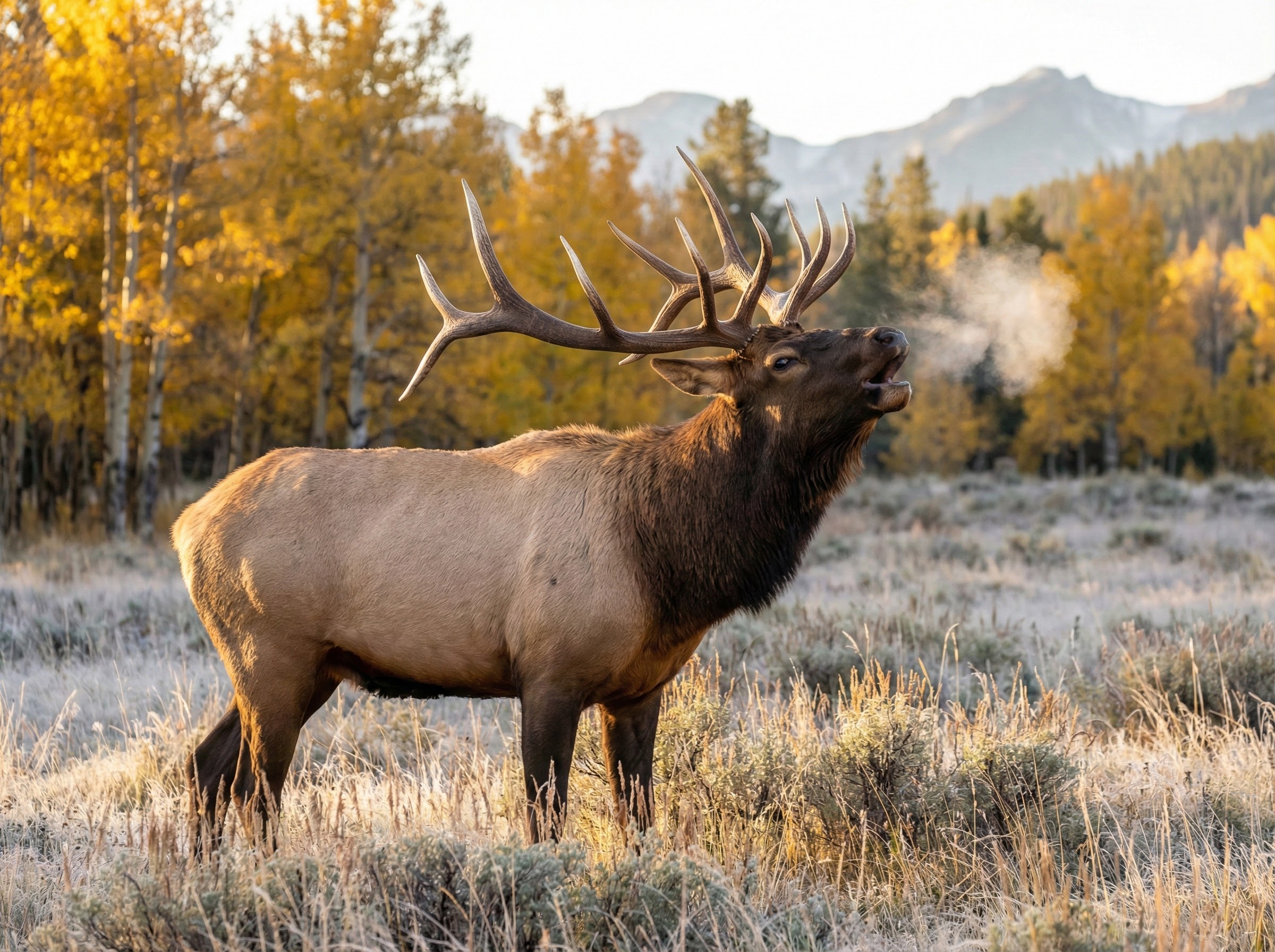
Rocky Mountain Elk
Cervus canadensis nelsoni
The most widespread and commonly hunted elk subspecies in North America. Found throughout the Rocky Mountain states from Canada to New Mexico. Known for their spectacular antlers and haunting bugles during the September rut.
🎯 Identification
Bulls: Tan to dark brown body with darker head, neck, and legs. Large antlers (6 points per side typical for mature bulls). Distinctive bugling call during rut.
Cows: Lighter tan coloration, no antlers. Smaller body size. Communicate with mews and chirps.
Antlers: Shed in March-April, regrow through summer, harden by August. Rubbed velvet before rut.
🌍 Habitat & Range
Found from Alberta and British Columbia south through Montana, Wyoming, Colorado, Idaho, and into New Mexico and Arizona. Prefer semi-open forest, alpine meadows, and mountain parks.
Summer: High elevation meadows and north-facing slopes (8,000-12,000 ft)
Winter: Lower elevations with less snow, south-facing slopes, valley bottoms
🍽️ Diet & Feeding
Elk are primarily grazers, consuming grasses, forbs, and sedges. Also browse on shrubs and tree bark.
- Feed most actively at dawn and dusk
- Mid-day bedding in timber or shade
- Prefer lush meadows and grasslands
- Water daily, especially in dry conditions
👥 Social Structure
Highly social animals that form herds. Social structure changes with seasons.
Spring-Summer: Cows, calves, and yearlings in nursery herds. Bulls in bachelor groups.
Rut (September): Bulls gather harems of 5-30 cows. Aggressive toward other bulls.
Winter: Large mixed herds for survival and predator protection.
🌲 Conservation Corner
Population Status: Rocky Mountain elk populations are thriving today with over 1 million animals across North America. This is a remarkable conservation success story, as elk were nearly extinct in many areas by the early 1900s.
How Hunters Help: Hunters play a crucial role in elk conservation through license fees and excise taxes on hunting equipment (Pittman-Robertson Act). These funds support habitat restoration, wildlife management, and population monitoring.
Rocky Mountain Elk Foundation (RMEF): Since 1984, RMEF has conserved or enhanced over 8 million acres of elk habitat. Hunters and conservationists working together ensure healthy elk populations for future generations.
Habitat Restoration: Active management includes prescribed burns to improve meadow quality, migration corridor protection, and winter range enhancement programs.
🎓 Fun Facts for Kids!
- Speed Demons: Despite their large size, elk can run up to 40 mph! That's faster than the fastest human sprinter!
- Heavy Headgear: A mature bull elk's antlers can weigh up to 40 pounds - that's like carrying a small dog on your head all day!
- Super Loud Calls: An elk's bugle can be heard for miles across mountain valleys. It's one of the most distinctive sounds in nature!
- Spotted Babies: Baby elk (called calves) are born with white spots on their tan coats, just like deer fawns. The spots help camouflage them from predators.
- Massive Mammals: Elk are one of the largest land mammals in North America - only moose and bison are bigger!
- Antler Magic: Bull elk grow a completely new set of antlers every year. They can grow up to an inch per day during summer!
📢 Calling Recommendations for Rocky Mountain Elk
Location Bugle
Best at first light to locate responsive bulls. Use sparingly to avoid educating elk.
Cow Calls
Highly effective throughout the rut. Start soft and increase intensity if bull responds.
Challenge Bugle
Use during peak rut on aggressive bulls. Can backfire on pressured elk or late season.
Estrus Whine
Most effective mid-September during peak breeding. Can bring bulls from long distances.
📅 Seasonal Behavior - Rocky Mountain Elk
March - May (Spring)
Bulls shed antlers. Calving occurs in late May-early June. Elk move to higher elevations as snow melts. Cows seek isolated areas for calving.
June - August (Summer)
Bulls grow new antlers in velvet. Elk at highest elevations feeding heavily. Bachelor groups form. Minimal vocalization. Velvet shed in late August.
September (Peak Rut)
Peak breeding activity. Bulls bugle constantly, especially at dawn/dusk. Aggressive interactions between bulls. Best time for calling. Bulls barely eat, focused on breeding.
October (Late Rut)
Tail end of rut. Bulls exhausted and less vocal. Some late breeding activity. Bulls begin separating from cow herds. Hunting can still be productive with cow calls.
November - February (Winter)
Large mixed herds form. Migration to lower elevations. Focus on survival and feeding. Bulls recover body condition. Minimal vocalization.
Roosevelt Elk
Cervus canadensis roosevelti
The largest-bodied elk subspecies in North America. Found in the coastal rainforests of the Pacific Northwest from northern California through British Columbia. Named after President Theodore Roosevelt.
🎯 Identification
Physical Traits: Darker coloration than Rocky Mountain elk. Heavier body mass. Shorter, thicker antlers relative to body size. More compact build suited to dense forest habitat.
Antlers: Typically 4-6 points per side. Shorter main beams but massive bases. Less "branchy" than Rocky Mountain elk.
🌲 Habitat & Range
Coastal temperate rainforests, dense timber, river valleys. Much wetter habitat than Rocky Mountain elk.
Primary Range: Olympic Peninsula (Washington), coastal Oregon, northern California, Vancouver Island
Habitat Features: Dense understory, old-growth forest, river bottoms, clear-cuts with regeneration
🎯 Hunting Strategies
Roosevelt elk hunting differs significantly from Rocky Mountain elk due to habitat:
- Dense timber requires close-range encounters
- Calling less effective due to thick cover
- Still-hunting and spot-and-stalk more common
- Focus on trails, wallows, and clearings
- Weather systems influence movement
📢 Vocalization Differences
Roosevelt elk bugle less frequently than Rocky Mountain elk. Calls tend to be deeper and more guttural. Cow calls still effective but bulls may be silent for days. Focus on listening for brush crashing and antler raking.
📅 Understanding the Elk Rut
The elk rut is a 6-8 week period in early fall when bulls compete for breeding rights with cows. Understanding rut phases is critical for successful calling and hunting strategies.
1️⃣ Pre-Rut (Late August - Early September)
Timing: Final 2 weeks before peak rut
Bull Behavior: Bulls begin separating from bachelor groups. Testosterone rising. Sporadic bugling, mostly at dawn. Testing vocalizations. Sparring with other bulls.
Calling Strategy: Location bugles at first light. Soft cow calls. Don't over-call. Bulls are hesitant and cautious. Focus on scouting and locating.
2️⃣ Peak Rut (Mid-September)
Timing: Typically September 10-25 (varies by elevation and latitude)
Bull Behavior: Maximum aggression and vocalization. Bulls gather harems. Bugling constantly. Aggressive toward other bulls. Barely eating or resting. Fighting for dominance.
Calling Strategy: Most responsive period. Use all call types. Challenge bugles can work on aggressive bulls. Cow calls highly effective. Bulls may come charging in.
3️⃣ Second Rut (Late September - Early October)
Timing: Approximately 18-21 days after peak rut
Bull Behavior: Cows that didn't breed come into estrus again. Reduced vocalization. Bulls are tired but will respond to breeding opportunities. More cautious.
Calling Strategy: Focus on cow calls and soft bugles. Estrus whines can be deadly. Don't over-call. Use natural cow vocalizations to bring bulls in silently.
4️⃣ Post-Rut (October)
Timing: After breeding cycle completes
Bull Behavior: Exhausted and recovering. Minimal vocalization. Focused on feeding to regain weight. May respond to calls but unlikely to bugle back. Moving to winter range.
Calling Strategy: Soft cow calls only. Be patient. Bulls may come in silently. Focus on feeding areas and transition routes rather than calling.
🌡️ Factors Affecting Rut Timing
- Elevation: Higher elevation herds rut earlier (late August-early September). Lower elevation can be 2-3 weeks later.
- Latitude: Northern herds (Montana, Idaho) rut earlier than southern (New Mexico, Arizona).
- Weather: Cold fronts and temperature drops trigger increased activity. Full moons can affect movement patterns.
- Hunting Pressure: Heavy pressure can make bulls silent and nocturnal, even during peak rut.
- Bull-to-Cow Ratio: Areas with many bulls see more aggressive behavior. Areas with few bulls may have quieter ruts.
🌅 Daily Activity Patterns
Dawn (4:30-8:00 AM): Peak activity period. Bulls bugle most actively. Elk move from bedding to feeding areas. Best time for calling.
Mid-Day (10:00 AM-4:00 PM): Elk bed in thermal cover. Bulls may still bugle sporadically during peak rut. Good time to set up near bedding areas.
Dusk (5:00-8:00 PM): Second peak activity. Bulls bugle again. Elk move to feeding areas. Another prime calling window.
Night: Bulls may bugle through the night during peak rut. Feeding and movement continues. Less productive for hunting.
🌡️ Weather Influences
- Cold Fronts: Dramatically increase activity. Bulls bugle more. Movement increases. Best hunting conditions.
- Rain: Elk often more active during light rain. Reduces hunting pressure. Masks scent and sound.
- Wind: Elk bed in protected areas. More difficult to pattern. Focus on wind shadows and terrain features.
- Snow: Triggers migration to lower elevations. Concentrates elk in specific areas.
- Hot Weather: Reduced activity. Elk seek water and shade. Focus on north-facing slopes and water sources.
🎯 Bull Response to Calls
Silent Approach: Many bulls, especially mature ones, come to calls silently. Never assume no response means no bull. Stay alert.
Hanging Up: Bulls often stop 100-200 yards away. Use cow calls to coax them closer. Be patient. They may stand for 20+ minutes.
Circling: Bulls frequently circle downwind to smell you. Set up with wind advantage. Have shooter positioned for downwind approach.
Running In: Satellite bulls may charge in quickly. Be ready immediately after calling. This happens more often than with mature bulls.
👃 Elk Senses
Smell (Best Sense): Elk can detect scent from hundreds of yards. Wind is the most critical factor in elk hunting. Always approach from downwind.
Hearing (Second Best): Excellent hearing. Can pinpoint call locations. Use terrain to muffle sound. Natural calls are critical.
Eyesight (Third): Good at detecting movement but not detail. Full camouflage important. Remain motionless when elk are visible.
💧 Water Sources
Elk require water daily, especially in dry conditions. Wallows are particularly important during the rut:
- Bulls wallow to cool down and spread scent
- Wallowing peaks during hottest part of day
- Fresh wallows indicate recent bull activity
- Set up near active wallows mid-day
- Wallows often near bedding areas in timber
🌲 Terrain & Movement
Ridge Running: Elk often travel on ridges for wind advantage and visibility. Good ambush locations.
Saddles: Natural travel corridors between drainages. Excellent setup locations.
Timber Edges: Elk prefer feeding in meadows but stay close to timber escape cover.
Transition Zones: Areas between bedding and feeding zones see concentrated movement at dawn/dusk.