🦌 Whitetail Species Guide
POPULAR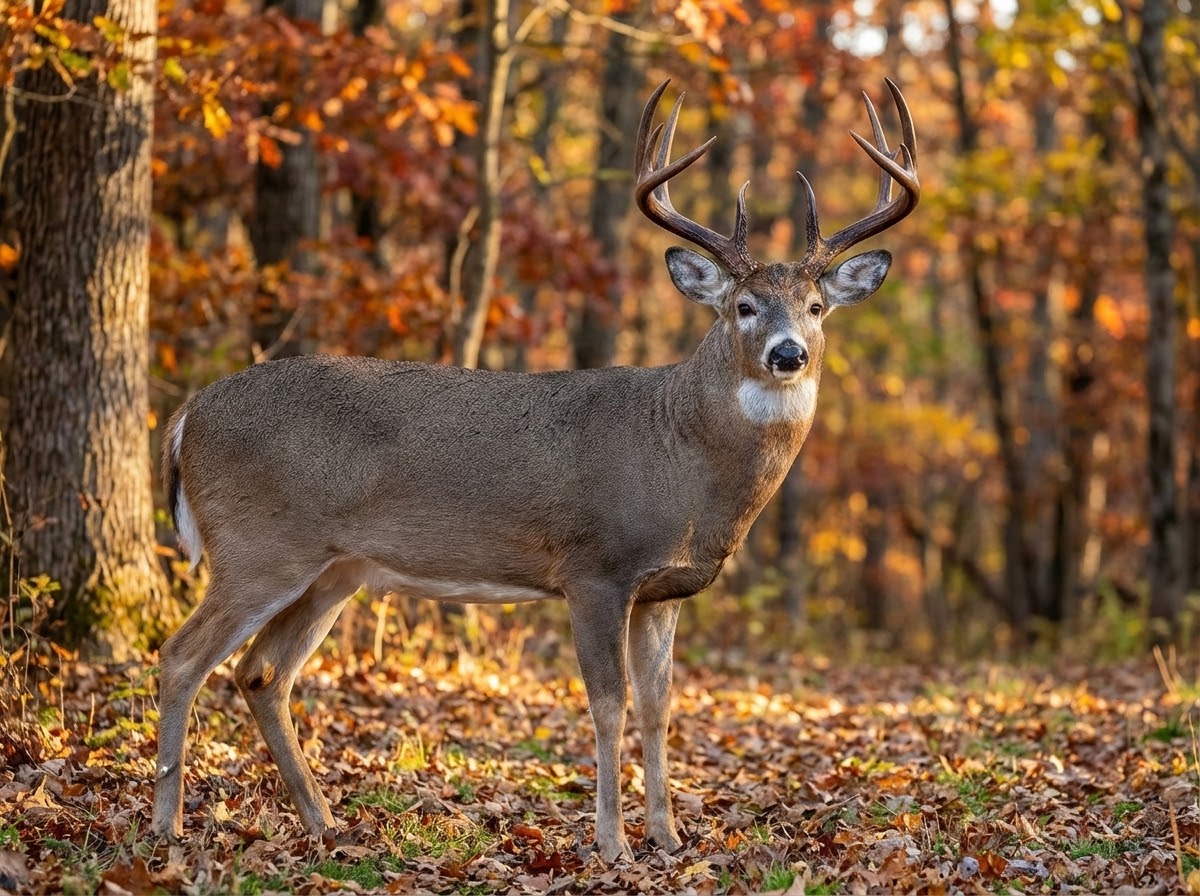
White-tailed Deer
Odocoileus virginianus
The most widely distributed big game animal in North America. Whitetails are highly adaptable, living in diverse habitats from Canada to South America. Known for their incredible wariness and the distinctive white underside of their tail used as an alarm signal.
🎯 Identification
Buck: Develop antlers annually, shed in late winter (Jan-Mar). Antlers grow from pedicles on skull. Mature bucks have larger bodies, thick necks during rut, tarsal glands stained dark.
Doe: No antlers (rare exceptions). Smaller body, slender neck year-round. Both sexes have white tail underside, raised when alarmed creating the distinctive "flag."
🌍 Habitat & Range
Found throughout North America except Southwest deserts. Prefer edge habitat—transition zones between forests and fields. Optimal habitat includes:
- Food sources: acorns, agricultural crops, browse
- Cover: thick vegetation for bedding security
- Water: within 1/4 mile of bedding areas
- Travel corridors: connecting food and bedding
🍽️ Feeding Behavior
- Ruminants with 4-chambered stomach
- Browse: woody vegetation, leaves, twigs
- Mast: acorns (white oak preferred, red oak fallback)
- Agriculture: corn, soybeans, wheat, clover
- Peak feeding: last hour of light, first hour of dawn
- Require 5-9 lbs of food daily depending on season
👃 Senses
- Scent: Exceptional—can detect human odor 1/4 mile away. 297 million olfactory receptors (humans have 5 million)
- Hearing: Can rotate ears independently, detect high-frequency sounds humans can't hear
- Vision: 310-degree field of view. Excellent motion detection but poor detail. See blues/greens best, reds poorly
🌿 Conservation Corner
Population Status: Whitetail deer are a conservation success story! Over 30 million whitetails currently thrive across North America, compared to fewer than 500,000 in the early 1900s.
How Hunters Help: Through license fees, excise taxes on hunting equipment (Pittman-Robertson Act), and habitat stamps, hunters contribute over $1.6 billion annually to wildlife conservation. These funds support habitat restoration, research, and wildlife management programs.
Habitat Management: Conservation efforts include creating food plots, managing forest succession, protecting critical winter habitat, and maintaining travel corridors. Controlled hunting helps maintain healthy herd densities, preventing overpopulation that leads to starvation, disease, and habitat degradation.
🎉 Fun Facts for Kids!
- Amazing Jumpers: Deer can jump 8 feet high and leap 30 feet in a single bound—that's longer than a school bus is wide!
- Super Smellers: A deer's nose has 297 million scent receptors, while humans only have 5 million. They can smell things we can't even imagine!
- Natural Camouflage: Baby deer (called fawns) are born with white spots on their fur that look like sunlight coming through leaves. This helps hide them from predators!
- Speed Demons: Deer can run up to 30 miles per hour—that's as fast as a car driving through your neighborhood!
- Incredible Growth: Deer antlers are the fastest growing tissue in the entire animal kingdom. A buck's antlers can grow up to 1/4 inch per day during summer!
📅 Annual Rut Cycle
Pre-Rut (September - Early October)
Bucks shed velvet, establish dominance hierarchies through sparring. Begin making scrapes and rubs to mark territory. Testosterone rising but does not yet receptive. Light calling and rattling can work. Focus on food sources.
Seeking Phase (Mid-October)
Bucks actively searching for does entering estrus. Increase scrape and rub activity. Cruising travel corridors and doe bedding areas. Calling effectiveness increases. Grunt calls and doe bleats productive.
Chasing Phase (Late October)
Bucks begin aggressively pursuing does. First does coming into estrus. Bucks throw caution to the wind. Peak calling period—tending grunts and estrus bleats highly effective. Rattling works well. All-day movement possible.
Breeding Phase (Early-Mid November)
Peak rut. Mature bucks locked down with hot does. May see less daytime movement as bucks are bedded with does. When does breed, bucks immediately seek next receptive doe. Timing is critical—hunt does' areas.
Post-Rut (Late November)
Most does bred. Bucks exhausted, recuperating. Movement decreases. Focus on food sources as bucks replenish energy. Calling effectiveness drops significantly. Scout for late-cycling does.
Second Rut (December)
Does that didn't breed in November cycle again 28 days later. Also, fawns reaching breeding age. Less intense than primary rut but can see good buck movement for 3-5 days. Localized activity—not every area experiences this.
📢 Calling Strategy by Rut Phase
Pre-Rut: Social Calls
Contact grunts, light doe bleats. Keep it subtle and infrequent. Bucks are still in bachelor groups and wary.
Seeking Phase: Increase Aggression
Tending grunts, estrus bleats, light rattling. Bucks actively searching and responsive. Call every 20-30 minutes.
Peak Rut: All-In
Everything works. Aggressive rattling, snort-wheeze, urgent estrus bleats. Bucks respond to competition and breeding opportunities.
Post-Rut: Back to Basics
Return to subtle contact grunts and bleats. Save energy—calling effectiveness low. Focus on visual attractants instead.
🌙 Activity Patterns
Crepuscular: Most active dawn and dusk. Peak movement occurs in the 30 minutes before sunrise and the last hour of daylight.
Moon Phase: Controversial topic. Many hunters believe full moons increase nighttime activity, reducing daytime movement. New moons may increase daytime movement.
Weather: Cold fronts trigger movement. Deer feed heavily before storms. Barometric pressure drops can increase activity.
🛏️ Bedding Behavior
- Bucks prefer high ground with view of surroundings
- Does bed in groups, often in thick cover
- Thermal cover important in winter
- Bed with wind at back, watching downwind
- May have multiple beds in core area
- Bed 70-80% of the day outside rut
🚶 Travel Patterns
- Prefer edges and funnels—least-resistance routes
- Use same trails repeatedly if undisturbed
- Mature bucks travel downwind of doe areas
- Core area typically 640 acres for does
- Mature bucks may range 2-3 square miles
- During rut, bucks expand range 200-300%
⚠️ Alarm Responses
- Stomp: Front hoof stomp when uncertain
- Snort: Loud exhale when alarmed but not fleeing
- Blow: Multiple sharp snorts when fleeing
- Flag: Tail up showing white when running
- Freeze: Stand motionless to assess threat
🌱 Quality Deer Management Principles
QDM is a management philosophy that produces biologically and socially balanced deer herds within the environment's carrying capacity. The goal is healthy deer populations, improved herd quality, and enhanced hunting experiences.
Core Principles
- Herd Balance: Maintain proper buck:doe ratios (1:2 to 1:4 ideal)
- Age Structure: Protect yearling bucks to reach maturity
- Doe Harvest: Harvest does to maintain density within carrying capacity
- Habitat: Improve nutrition and cover through habitat work
Aging Bucks
- 1.5 years: Body resembles large doe. Thin neck, straight back, legs appear long
- 2.5 years: Muscle development begins. Neck starts to swell during rut
- 3.5 years: Mature body. Thick neck during rut, chest deeper than hindquarters
- 4.5+ years: Fully mature. Thick neck year-round, belly sag, gray face, swayed back
Antler Development
Antler growth determined by three factors in order of importance:
- Age: Bucks need 4.5-5.5 years to reach genetic potential
- Nutrition: Quality food year-round, especially spring/summer
- Genetics: Only matters if age and nutrition optimized
Most bucks reach 90% of antler potential by 5.5 years. Spike bucks in year one typically develop normal racks at maturity given proper nutrition.
Doe Management
- Critical to herd health and buck growth
- Overpopulation leads to malnutrition, disease
- Target: 30-40 deer per square mile (varies by region)
- Harvest does to balance herd with food availability
- Fawns comprise 30-40% of healthy herd